Sunday, December 10, 2006
It doesn't get dark easily after the sunset in the plains. In this regard, Helsinki is like Delhi, where the evening stretches on and on, long after the sun has set. Today I could often catch a glimpse of the bright blue sky behind the dark clouds, some 30 minutes after the official sun set time. In the mountains, however, it gets dark very fast. Moments after the Sun sinks below the horizon, darkness appears from nowhere, enveloping everything in its thick shroud.
Tuesday, December 05, 2006
Saturday, December 02, 2006
Friday, November 24, 2006

The peculiar weather, westerly winds, occasional fog together with the mild sun create a mystical aura about Helsinki. It probably has to do with being situated at 60 degrees N latitute. The lighting is intensive and delightful here. Whenever the Sun decides to peep out from the cloud cover, he creates wonderful patterns in the sky, drawing all attention to himself. At times as mild as the moon even at noon, yet at times dazzling even if his weak rays try in vain to pierce the freezing blanket of air. The conifer trees and the leafless temperate trees add to this aura, creating a beauty that is almost divine.
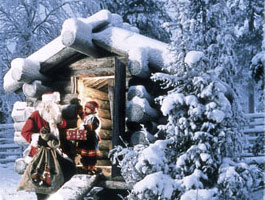
Santa Village at Rovaniemi

Santa's Office

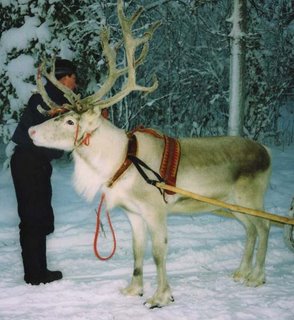
Reindeer
Santa's Cabin in the fell at Rovaniemi

Sunday, November 12, 2006
Bangalore , India, as a visiting expert.
____________ _________ _________ _____
Driving in Bangalore/ India.
For the benefit of every Tom, Dick and Harry visiting India and daring to drive on Indian roads, I am offering a few hints for survival. They are applicable to every place in India except Bihar,here life outside a vehicle is only marginally safer.
Indian road rules broadly operate within the domain of karma where you do your best, and leave the results to your insurance company. The hints are as follows: Do we drive on the left or right of the road? The answer is "both". Basically you start on the left of the road, unless it is occupied. In that case, go to the right, unless that is also occupied. Then proceed by occupying the next available gap, as in chess. Just trust your instincts, ascertain the direction, and proceed. Adherence to road rules leads to much misery and occasional fatality. Most drivers don't drive, but just aim their vehicles in the generally intended direction.
Don't you get discouraged or underestimate yourself except for a belief in reincarnation; the drivers are not in any better position.
Don't stop at pedestrian crossings just because some fool wants to cross the road. You may do so only if you enjoy being bumped in the back.
Pedestrians have been strictly instructed to cross only when traffic is moving slowly or has come to a dead stop because some minister is in town. Still some idiot may try to wade across, but then, let us not talk ill of the dead.
Blowing your horn is not a sign of protest as in some countries. We horn to express joy, resentment, frustration, romance and bare lust (two brisk blasts),or just mobilize a dozing cow in the middle of the bazaar.
Keep informative books in the glove compartment. You may read them during traffic jams, while awaiting the chief minister's motorcade, or waiting for the rainwater to recede when over ground traffic meets underground drainage.
Occasionally you might see what looks like a UFO with blinking colored lights and weird sounds emanating from within. This is an illuminated bus, full of happy pilgrims singing bhajans. These pilgrims go at breakneck speed, seeking contact with the Almighty, often meeting with success.
Auto Rickshaw (Baby Taxi): The result of a collision between a rickshaw and an automobile, this three-wheeled vehicle works on an external combustion engine that runs on a mixture of kerosene oil and creosote. This triangular vehicle carries iron rods, gas cylinders or passengers three times its weight and dimension, at an unspecified fare. After careful geometric calculations, children are folded and packed into these auto rickshaws until some children in the periphery are not in contact with the vehicle at all. Then their school bags are pushed into the microscopic gaps all round so those minor collisions with other vehicles on the road cause no
permanent damage. Of course, the peripheral children are charged half the fare and also learn Newton's laws of motion enroute to school.
Auto-rickshaw drivers follow the road rules depicted in the film Ben Hur, and are licensed to irritate.
Mopeds: The moped looks like an oil tin on wheels and makes noise like an electric shaver. It runs 30 miles on a teaspoon of petrol and travels at break-bottom speed. As the sides of the road are too rough for a ride, the moped drivers tend to drive in the middle of the road; they would rather drive under heavier vehicles instead of around them and are often "mopped" off the tarmac.
LeaningTower of Passes: Most bus passengers are given free passes and during rush hours, there is absolute mayhem. There are passengers hanging off other passengers, who in turn hang off the railings and the overloaded bus leans dangerously, defying laws of gravity but obeying laws of surface tension. As drivers get paid for overload (so many Rupees per kg of passenger), no questions are ever asked. Steer clear of these buses by a width of three passengers.
One-way Street: These boards are put up by traffic people to add jest in their otherwise drab lives.
Don't stick to the literal meaning and proceed in one direction. In metaphysical terms, it means that you cannot proceed in two directions at once. So drive as you like, in reverse throughout, if you are the fussy type. Least I sound hypercritical, I must add a positive point also.
Rash and fast driving in residential areas has been prevented by providing a "speed breaker"; two for each house. This mound, incidentally, covers the water and drainage pipes for that residence and is left untarred for easy identification by the corporation authorities, should they want to recover the pipe for year-end accounting.
Night driving on Indian roads can be an exhilarating experience for those with the mental make up of Genghis Khan. In a way, it is like playing Russian roulette, because you do not know who amongst the drivers is loaded. What looks like premature dawn on the horizon turns out to be a truck attempting a speed record. On encountering it, just pull partly into the field adjoining the road until the phenomenon passes.
Our roads do not have shoulders, but occasional boulders. Do not blink your lights expecting reciprocation. The only dim thing in the truck is the driver, and with the peg of illicit arrack (alcohol) he has had at the last stop, his total cerebral functions add up to little more than a naught. Truck drivers are the James Bonds of India, and are licensed to kill. Often you may
encounter a single powerful beam of light about six feet above the ground.
This is not a super motorbike, but a truck approaching you with a single light on, usually the left one. It could be the right one, but never get too close to investigate. You may prove your point posthumously.
Tuesday, September 12, 2006
I hail from a town in Andhra Pradesh, which is a district headquarter, but nowhere near the size of a city. I have done my schooling in this town and later moved to Hyderabad for my engineering where I had my share of cultural shocks.
Albeit the capital of AP and a place I frequently used to visit, I did see some new facets of the city when living there. The most striking features I noticed are the ease with which the Hindu and Muslim communities coexisted, which is a desirable feature and the indifference of the city, which I found very hard to digest.
One shocking incident that I remember too well is when a person on a bike slipped and fell on the road while I was waiting at a bus stop. It was a crowded place with lots of people just standing about and watching the fun. The guy who fell down was dazed a bit though he wasn’t hurt and had to bring himself together before he picked his bike up and rode away.
I found this in sharp contrast with the culture back home, where four to five people used to help me out even when I tripped from a bicycle. And where one or two phone calls were made to my father that I was seen driving fast later when I had a scooty.
Delhi, the huge metropolitan, where I had moved for my MBA at IIFT had more surprises in store for me. The major problem I faced was my inability to speak Hindi. I used to feel isolated in the mess, at the badminton court and sometimes even in the class when some professors used Hindi occasionally. I found the food a relatively bland. My mental blockages about north Indians being different also augmented the problem.
I found driving on the streets rash and that certain courtesies I used to take for granted aren’t there anymore. All these along with well-intentioned suggestions like “Don’t step out after dark”, “Don’t go for walks in Sanjay Van in the evenings even with friends”. It was a bit difficult since I come from a town where eve-teasing is almost non existent and its deemed safe, relatively at least.
I also found several of the north Indian guys to be condescending and with a general opinion that girls are inferior to them. This opinion is only reinforced when I was traveling in Punjab and UP along with rest of India for my summer project. I realized that this is due to the fact that in most of the families into business, male child is given very obvious preferential treatment, which is not very common in the South.
My roomies, both Delhiites, however, helped me adjust to the place and I started seeing the positive aspects of the city such as its flexibility, the way in which different cultures meet and coexist. Not only do they coexist, but they annihilate each other, merging into one common entity called the “Delhi Culture”, much the same way people living in Bombay are no longer Tamilians or Gujaratis, but are “Bombayyas”.
I also realized that most of the differences are only with regard to superficial aspects and deep down everyone is same (Might apply only to Indians not other country nationals). Once you get to know a person very well, the differences recognized are only due to the personality traits and not due to culture at all. I propose to examine this hypothesis very soon as I am availing of the exchange program to Finland. The Finns might as well turn out to be basically the same!!
Monday, July 17, 2006
Saturday, July 15, 2006
I have just finished reading the book 'Couplehood' by Paul Reiser. He's famous for the series 'Mad About You' and has authored another book called 'Babyhood'. Couplehood is a hilarious book about a typical couple living in the US. It entertains and pokes satires at the nuances of the modern life, much on the lines of 'The Bridget Jones' Diary'.
The book starts on page no. 147 - i.e., page no.1 is labelled as 147 and it goes on. This is because the author wants his readers to be able to say they are on page 154 although they've just read 7 pages. The satires start here..
This is how the protagonist feels when he looks into the mirror early in the morning.
"That's not what I was hoping for. I could have sworn I was better looking than that. I must be thinking of someone else."
And then there are two pages on the enjoyment of sitting. For instance, rather than moving to dislodge the remote control he's almost definitely sitting on, he'll just deal with the discomfort. He goes on to say, "...now if you understand how affection for sitting, multiply that a couple of times and you can imagine my enthusiasm for lying down." Another satire. There are several more on the ubiquitous "How are you?", friends meeting over for coffee, having kids and so on.
Towards the end, the book gets funnier and there are several jokes which make you laugh aloud. If you are looking for something very light to read at bed time, grab this one!
Tuesday, July 11, 2006
1) There would be 10 times as many people on the ship
2) There would be a song with Kate Winslet in a white saree and of course singing in the rain
3) The movie would be called "Pyar Kiya To Marna Kya"
4) Hero and Heroine would float in cold water for days and still survive, but the villian would die in the first dip
5) The iceberg would be sent by the heroine's father to teach the hero a lesson
6) None of the women would float due to heavy designer sarees. And last but not least
7) Half of the rescue boats would be reserved for SC/ST/OBC !!
Tuesday, January 31, 2006
I can't resist writing more about Mallik. The way he moulded and adapted himself to the new changes is amazing. He must be one of the few writers who predicted rightly the plight of the weekly magazines, the circulation of which stated declining rapidly after the emergence of IT. With IT infrastructure comparable to that in developed countries in place in all the major metros of India, the few previleged ardent fans of literature now use internet to read their favourite novels. For the others to whom these magazines just meant a way of killing time, there are a plethora of 'sas - bahu' and 'pinni' soaps on the TV.
There has also been a considerable shift in the reading habits in general. Not only have we started reading less, but we now read more of english publications now. It is very apparent - be it koti in Hyderabad or priya/chandinichowk in Delhi - the english books are everywhere. The readership of online newspapers and magazines is growing at a rapid pace - they are for free and offer flexibility of location. Today, I read Eenadu only on net. Mallik must have seen this coming. He became the editor of teluguone.com, a typical website with a mix of free and paid services. It has a library of few novels, weekly and daily serials and columns, paid movie and TV services, forums and mail options and has latest DVDs on sale. It is doing well, although it lacks the popularity of the likes of andhravilas. A great idea and a timely shift.